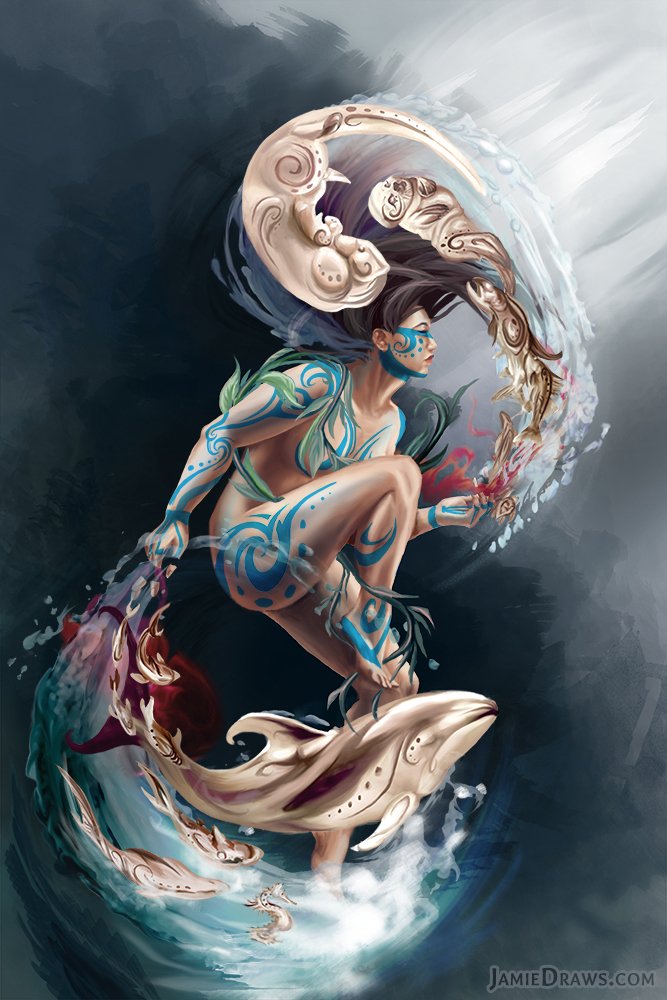
Sedna - Goddess of the Sea - Inuit Mythology

Deep beneath the Arctic waters lives Sedna, the powerful sea goddess of Inuit mythology. Her story is one of the most haunting and important in Inuit tradition; a tale of betrayal, transformation, and enduring power.

According to legend, Sedna was a young woman who was thrown into the icy sea by her own father. As she clung to the boat's edge, her father cut off her fingers one by one, and each severed piece sank into the ocean and became the seals, whales, and other sea creatures that Inuit communities have depended on for survival. Sedna herself sank to the ocean floor, where she became its ruler; the guardian of all marine life.

To this day, Sedna is honored and respected. When food grows scarce, shamans are said to journey down to comb her hair (since she has no fingers to do it herself) and calm her anger, so that she releases the animals of the sea back to the hunters above. Sedna's story reflects deep Inuit values: respect for nature, the balance between humans and animals, and the consequences of breaking that balance.

Want to dive deeper into her story? Check out the attached video to learn more about Sedna and her fascinating legend! 🌊

The audio and images below are the ones featured in the video.

Image Library

Audio Library

Comments

Popular posts from this blog

Hunab Ku - The Creator God - Maya Mythology

Hunab Ku is often described as the supreme creator deity in Maya cosmology; a formless, singular divine force believed to be the source of all life, movement, and measurement in the universe. The name itself is sometimes translated as "The One God" or "Giver of Movement and Measure," representing an abstract, all-encompassing power rather than a figure with a defined physical form, unlike many other gods in the Maya pantheon. According to tradition, Hunab Ku is considered the father of Itzamna, another major deity associated with wisdom, writing, and healing — linking this creator force directly to the broader web of Maya gods and the origins of humanity itself. It's worth noting that historians and Maya scholars actually debate how central Hunab Ku was in genuine pre-Columbian belief systems, since much of what's written about this deity comes from later colonial-era texts and modern reinterpretations rather than surviving classical Maya inscriptions....

The Nisser - Guardians of the Homestead - Scandinavian Mythology

In the quiet corners of Scandinavian folklore lives a small but mighty figure: the Nisse (or Nisser in plural). Picture a short, bearded old man in a red or grey wool cap, no taller than a child, quietly watching over a farm after dark. For centuries, Norwegian, Swedish, and Danish farmers believed a Nisse lived somewhere on the property; in the barn, the attic, or beneath the floorboards; protecting the home, the livestock, and the family's fortune. In return for this protection, families left out a bowl of porridge (often with a pat of butter on top) every night, especially around Christmastime. Forget the porridge, and the Nisse might turn mischievous — tangling animals' manes, misplacing tools, or causing minor chaos until respect was restored. Unlike the jolly gift-givers we associate with modern Christmas elves, the Nisse is older, stranger, and far more tied to the land itself. He's less about giving gifts and more about keeping order; a guardian spirit bound t...

The Legend of El Dorado - Muisca Mythology

Deep in the highlands of present-day Colombia, long before Spanish conquistadors arrived, the Muisca people practiced a sacred ritual on the shores of Lake Guatavita. Their new chief, covered head to toe in gold dust, would sail out on a raft laden with emeralds and golden offerings. As the sun rose, he would plunge into the icy waters, washing away the gold while his people cast treasures into the lake as gifts to their gods. This ceremony gave birth to the legend of "El Dorado"; the Golden One. When Spanish explorers heard whispers of a ruler who bathed in gold, the story transformed into a quest for a lost city of unimaginable riches. Expeditions scoured South America for centuries, chasing a city that never truly existed; because the real "El Dorado" wasn't a place at all. It was a person, a ritual, a moment of spiritual devotion. The myth endures today as a symbol of ambition, greed, and the collision between indigenous tradition and colonial obsessio...